

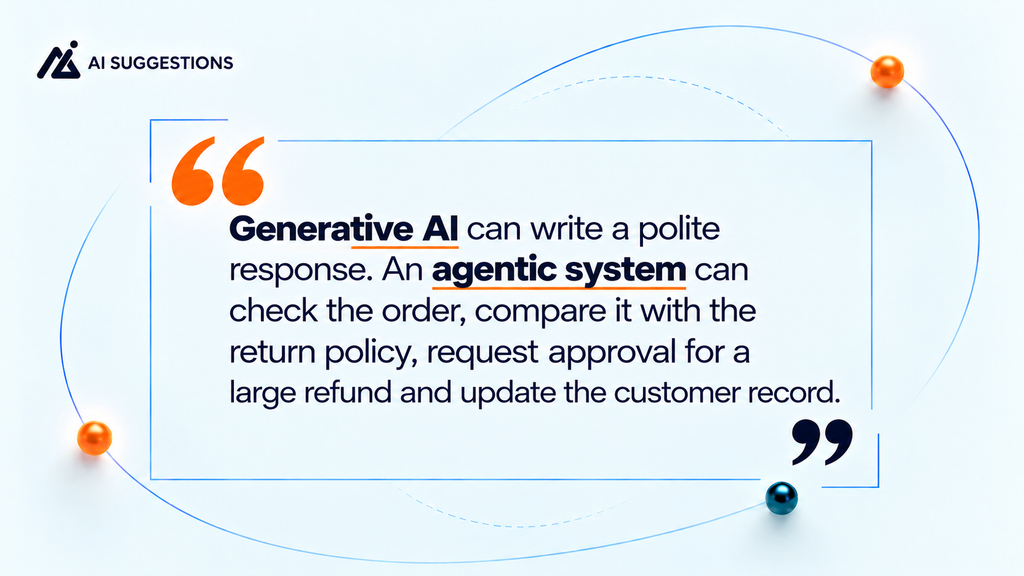
An AI that writes a refund email is useful. An AI that checks the order, reads the returns policy, decides whether the customer qualifies, issues the refund and updates the CRM has crossed into a different kind of work. That is the clearest way to understand agentic AI vs generative AI.
Generative AI creates an answer, image, summary or piece of code. Agentic AI works toward a goal by planning steps, using tools, checking results and deciding what to do next.
The terms still get used loosely, and vendors now call almost any chatbot an agent. In this guide, we explain how agents differ from assistants and automation, and where ordinary software remains the safer choice.
How is agentic AI different from generative AI? Generative AI creates content in response to a prompt. Agentic AI receives a goal and works through the steps needed to reach it. It may search for information, use software, check what happened and change its approach without waiting for instructions after every step.
The two are not rivals. Most agentic systems use generative AI to understand requests, make plans and communicate results.
| Area | Generative AI | Agentic AI |
| Main job | Creates or changes content | Completes a goal through several actions |
| Starting point | A prompt | A goal, rules and permissions |
| Typical output | Text, code, images or analysis | A completed task or updated system |
| Tool use | Optional | Usually essential |
| Next step | Chosen by the user | Chosen by the system within set limits |
| Memory | Usually limited to the conversation | Can retain task state and approved long-term information |
| Human role | Reviews and uses the output | Sets boundaries and approves sensitive actions |
| Main risk | A wrong or misleading answer | A wrong answer becoming a real action |
Generative AI creates new material from patterns learned during training. That material may be text, code, an image, audio, video or structured data.
The normal interaction is simple:
A model might summarize a contract, write a product description or suggest a block of Python. It has completed the generation task once it produces the answer. It does not normally open the company’s accounting system, make a payment and record the transaction.
Generative AI can still use tools. A chatbot may search the web or analyse a spreadsheet when asked. Tool access alone does not make it an agent. The important question is who controls the sequence of work. If the user keeps deciding and requesting each step, the system is behaving more like an assistant.
This is why the difference can become blurry. The same model can power a simple chatbot, a writing assistant or a more autonomous agent. The model creates the language; the surrounding system decides how much work it can perform.
Agentic AI is an AI system that can work toward a defined goal with limited supervision. Instead of producing one response and stopping, it can decide what to do next, use approved tools, inspect the result and continue until the job is finished or human input is required.
Anthropic defines an agent as a model that directs its own process and tool use rather than following a fixed script. In practice, that creates a repeating loop: plan, act, observe, adjust and try again.
A basic agentic loop looks like this:
1: Goal
2: Plan
3: Use a tool
4: Check the result
5: Continue, finish or ask for help
The agent does not need complete freedom. In fact, a useful business agent should have clear limits. A customer-service agent might issue refunds below $50 but send larger amounts to a manager. A coding agent may edit files and run tests but require approval before merging the change.
Agentic AI is therefore not a model that can “do anything.” It is a system made from several parts: a model, instructions, tools, memory, permissions and stopping rules. Google’s agent architecture describes these supporting parts as orchestration, state, planning, tool access and memory.
The model supplies reasoning and language. The system around it decides what the agent can see, change and approve.
The difference between an AI agent vs AI assistant is who controls the next step.
An assistant helps while a person drives the work. It answers a question, drafts an email, summarizes a document or recommends an action. The person reviews that output and decides what to request next.
An agent receives a goal and works through the process with less direction. It may decide which system to search, what information it needs and which approved action should follow.
| AI Assistant | AI Agent |
| Waits for a request | Works toward a defined goal |
| Usually completes one task at a time | Can manage several connected steps |
| Suggests what the user should do | Can perform approved actions |
| Relies on the user to continue the process | Decides when to continue, stop or ask for help |
| Usually works within a conversation | Can work across tools and systems |
The line is not fixed. An assistant becomes more agentic as it gains tools, memory and permission to continue without a new prompt. That is why a product may behave like an assistant in one mode and an agent in another.
ChatGPT is an AI assistant during a normal conversation: you ask, it answers and waits. It can behave as an agent when using features that complete multi-step work through files, apps, web tools or computer control. OpenAI’s workspace agents can also run repeatable workflows, use connected apps and complete scheduled tasks.
Both agents and automation can complete work without a person performing every step. The difference is how the path is chosen.
Traditional automation follows a path designed in advance:
When X happens, check Y. If Y is true, perform Z.
For example, an e-commerce system may automatically send a confirmation email whenever an order is placed. The trigger, condition and action are already known.
An AI agent starts with an outcome and can choose between several possible steps. If a customer asks for a refund, the agent may need to find the order, identify the problem, read the relevant policy, check the payment status and decide whether the request requires approval.
| Area | Traditional Automation | AI Agent |
| Process | Predetermined | Chosen while the task is running |
| Inputs | Usually structured and predictable | Can include emails, documents and unclear requests |
| Decision-making | Uses fixed conditions | Uses context to select the next action |
| Consistency | High | Lower because model output can vary |
| Best use | Repetitive, stable processes | Variable work with several possible paths |
| Main weakness | Breaks when an unexpected case appears | May choose the wrong path |
Automation can include generative AI without becoming agentic. A workflow might send every support email to a model for classification and then follow fixed rules. The model interprets the message, but the automation still controls every following step.
An agent can also operate inside an automation. A normal workflow may trigger the agent, allow it to handle the uncertain part and then return the result to a fixed process.
AWS describes the same split: automation follows predefined rules, while agents can adapt their decisions around changing inputs. The harder technology is not always the better one. If five fixed rules can complete a task safely, adding an agent usually creates more cost, delay and uncertainty.
A language model alone can generate a plan. It needs a system around it to carry that plan into the real world.
The model reads the request, available context and rules. It breaks the goal into smaller steps and selects what to do first.
For a refund request, it may decide that it needs the order record, return policy and delivery status before making a recommendation.
Tools give the agent controlled access to other systems. Depending on its job, an agent might be allowed to:
The agent does not magically know how to access these systems. A developer or platform must provide each connection and define what the tool is allowed to do.
“Memory” can describe three different things:
An agent does not need unlimited memory. It needs the right information at the point where a decision is made. Saving everything can raise costs, preserve incorrect details and expose sensitive data.
After using a tool, the agent reads the result. If the order number is invalid, it may search another system or ask the customer to confirm it. If the refund succeeds, it can move to the next step.
This loop- plan, act, observe and adjust- is the part that makes the system agentic.
The most important component is not intelligence. It is authority.
A business must decide which information the agent can read, which records it can change, how much money it can spend and which actions require approval. OpenAI’s current guidance similarly recommends defining the outcome, approved sources, constraints and points where an agent must stop for review.
A well-designed agent does not have maximum freedom. It has enough access to complete its job and no more.
The easiest way to recognize agentic AI is to look for a task that continues after the first answer.
A generative model can draft a reply. An agent can identify the customer, check the order, read the return policy, decide whether the request fits its rules, update the ticket and prepare the response. It should send large refunds, unusual complaints and unclear cases to a person.
Coding agents can inspect a repository, find related files, edit code, run tests and respond to failures. Our Claude Code review and Cursor review show why this is more than code generation: the agent must keep working after the first patch and check whether the change actually works.
A research agent can split a question into smaller parts, run several searches, compare sources and produce a cited report. It becomes agentic when it chooses which searches to run and changes direction after finding missing or conflicting evidence.
Our Perplexity review explains how a research-first product differs from a general chatbot. The final report still needs fact-checking because an agent can attach a real source to a claim that the source does not fully support.
An agent may read CRM notes, check recent emails, research an account and prepare a meeting brief. Another might review a new lead, collect missing details and assign it to the correct salesperson.
These workflows often combine agents with normal automation. A fixed calendar event can trigger the task; the agent handles the messy research and decision-making in the middle.
Businesses need agents when the work changes from case to case but still has a clear goal, approved tools and rules for success.
| Work You Need Completed | Best Fit |
| Create one answer, image, summary or draft | Generative AI |
| Help a person complete each step | AI assistant |
| Repeat the same steps using clear conditions | Automation |
| Choose between several possible steps | AI agent |
| Decide with serious legal, financial or safety consequences | Human-led process with limited AI support |
Useful AI agents for business handle variation that would make a fixed workflow difficult to maintain. Support requests arrive in different formats. Research uncovers unexpected gaps. Software tests fail for different reasons. The goal stays stable, but the path does not.
If the business can write every step as a dependable rule, normal automation will usually be cheaper, faster and easier to audit.
Platforms such as Zapier and Make can combine fixed workflows with AI-powered steps. That is often enough. A company does not need to hand the full process to an agent simply because one step involves language or judgment.
If the first answer is no, use automation. If the remaining answers are no, the process is not ready for an agent.
Generative AI can give you a wrong answer. An agent can turn that answer into a wrong action.
A model may misunderstand a policy, invent a missing detail or choose the wrong customer record. If it can update systems, send messages or move money, the mistake no longer stays inside a draft.
High-impact actions should require approval. Low-impact actions still need logs, limits and a way to reverse changes.
Agents often read emails, webpages, documents and code written by other people. One of those sources may contain instructions designed to manipulate the model.
NIST identifies this as agent hijacking, also called indirect prompt injection. Its research warns that agents working with outside data can be tricked into using their tools in unintended ways.
An agent should treat outside content as data, not trusted instructions.
An agent that only drafts an email can produce a bad draft. An agent with access to email, CRM records, payment tools and customer files can create a much larger problem.
Permissions should follow the same rule used for employees and software accounts: give the agent only the access required for its job.
Every extra search, tool call and retry adds time and cost. It also creates another point where the agent can misunderstand a result.
Multi-agent systems can increase this problem. One agent may pass incomplete information to another, making the final error harder to trace.
Long-term memory can make an agent more useful, but it can also retain an outdated preference, incorrect fact or sensitive detail. Businesses need rules covering what can be saved, how long it remains and who can correct or delete it.
Anthropic’s guidance on trustworthy agents focuses on human control, secure tool use, transparency and privacy for this reason.
| The more freedom an agent receives, the tighter its permissions, logs and approval rules should become. |
Agentic AI is an AI system that works toward a goal by planning steps, using approved tools and adjusting after each result. Unlike a basic chatbot, it can continue working without waiting for a new prompt at every stage.
Generative AI creates content such as text, images or code. Agentic AI manages a task from start to finish. It may use generative AI to understand instructions, but it also needs tools, memory and decision-making to act.
ChatGPT is usually an AI assistant in a normal conversation. It becomes more agentic when features such as Work, Codex or workspace agents can use tools, complete several steps or run recurring tasks. The answer depends on the mode and permissions being used.
An AI assistant helps a person decide what to do. An AI agent can choose and perform the next permitted action itself. The line can blur because adding tools, memory and greater autonomy can make an assistant behave more like an agent.
No. Traditional automation follows rules and paths written in advance. An AI agent can choose a different path when the input or result changes. Use automation for stable, predictable work; use agents when the task genuinely requires judgment and adaptation.